
A plain-language summary of a published scientific study. It is educational and does not replace medical advice.
The study: Park K et al., Annals of Laboratory Medicine, published online 19 August 2026. A case report (letter to the editor), South Korea. Free full text.
What the researchers studied
A 69-year-old woman had a 10-year history of gradually worsening walking problems: first stiff legs and an awkward gait, then frequent falls, and a year earlier she had started to need a quad cane. Her mother and maternal grandfather had had similar problems, and two of her siblings were affected. Everyone affected first had symptoms after age 50.
What they found
- Genetic testing found a new SPAST variant in an intron (a stretch of the gene between the parts that code for the protein), just before exon 13.
- Software predicted that the variant makes the cell "skip" exon 13 when reading the gene. A test on the patient's RNA confirmed this, and the variant was classified as likely pathogenic.
- After 6 weeks of rehabilitation and anti-spasticity medication, her stiffness eased and her stability improved.
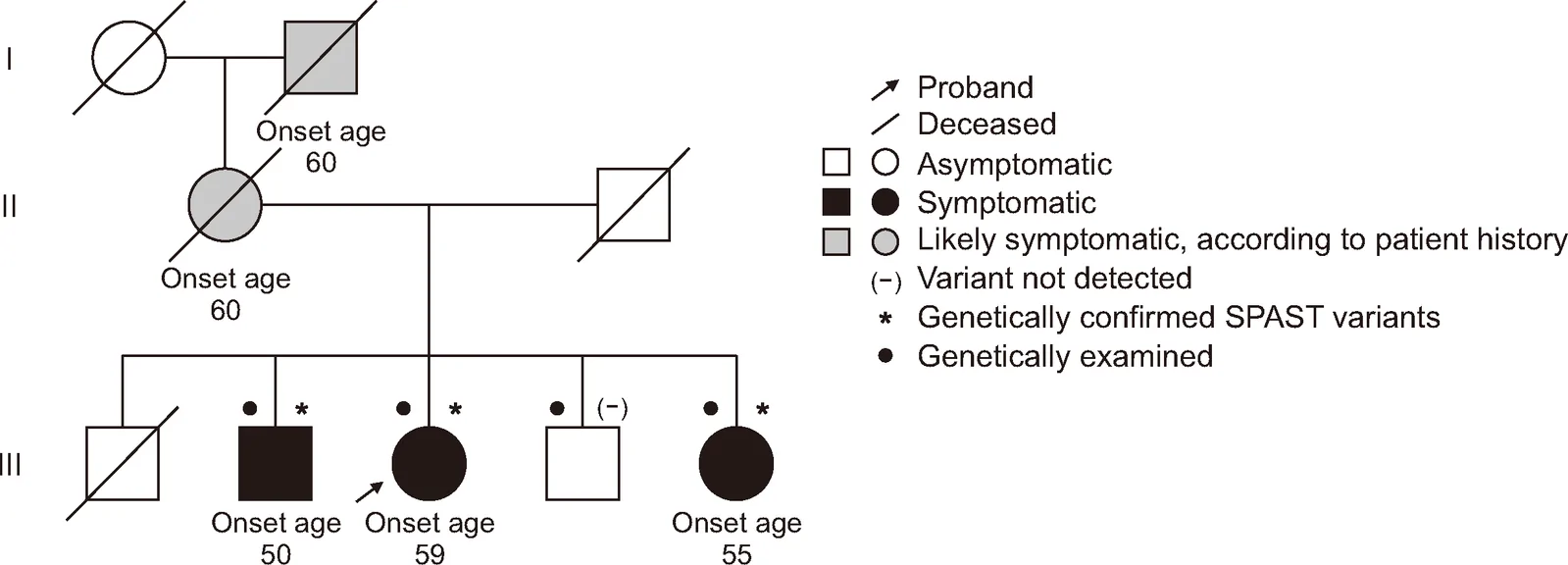
Figure 1 from the study: the family tree. Every affected member first had symptoms after 50, and the condition passed from generation to generation (autosomal dominant inheritance). Source: Fig. 1 from Park K et al. “Late-Onset Hereditary Spastic Paraplegia with a Novel SPAST Intronic Variant.” Ann Lab Med 2026. doi:10.3343/alm.2026.0271. Licensed CC BY-NC 4.0.
What it means for families
- SPG4 can begin at very different ages: first symptoms can appear anywhere between age 1 and 76. The authors note that the median age of onset is about 30.
- Some variants are not in the parts of the gene that directly code for the protein, and their effect cannot be settled from DNA alone. An RNA test can clarify an inconclusive result.
- Rehabilitation clearly helped this patient.
What the study does not tell us yet
This is a single family. The authors suggest two possible reasons for the late onset and mild course: the cell still makes some normal RNA, or spastin keeps part of its function. Neither is proven yet.
References
- 1.
Park K, Koo WM, Kim JM, Kim DH (2026). Late-Onset Hereditary Spastic Paraplegia with a Novel SPAST Intronic Variant. Annals of Laboratory Medicine 46(6):747–749.
PMID 42613945Last verified: 7 November 2026
SPG4 starting after age 50, caused by a new intronic SPAST variant.
- 2.
Parodi L, Rydning SL, Tallaksen C, Durr A (2019). Spastic Paraplegia 4. GeneReviews®, University of Washington, Seattle (posted 2003; updated 13 June 2019).
PMID 20301339Last verified: 6 November 2026
The core clinical reference for SPG4: frequency, onset, symptoms, inheritance, diagnosis and symptomatic care.
Further sources
- DOI: 10.3343/alm.2026.0271 (opens in a new tab)doi.org
- PubMed Central: PMC13662478 (opens in a new tab)pmc.ncbi.nlm.nih.gov