
A plain-language summary of a published scientific study. It is educational and does not replace medical advice.
The study: Fattorini G et al., Annals of Clinical and Translational Neurology, published online 2 September 2026. A laboratory study using patient samples. Free full text.
What the researchers studied
A biomarker is a measurable sign that shows whether a disease is present, how it is progressing, or whether a treatment is working. SPG4 is the most common form of hereditary spastic paraplegia and is caused by variants in the gene that makes spastin. Strategies that try to restore spastin levels are being developed, but simple measures that clinical trials could use are missing.
The team tested one such measure: the distance between the nucleus and the centre of the cell (dcnc) in white blood cells called PBMCs. They used automated microscope imaging on samples from 48 people with genetically confirmed SPG4 and 21 healthy people.
What they found
- The dcnc distance told people with SPG4 apart from healthy people, regardless of variant type and disease severity.
- The less spastin there was in the cells, the larger the distance.
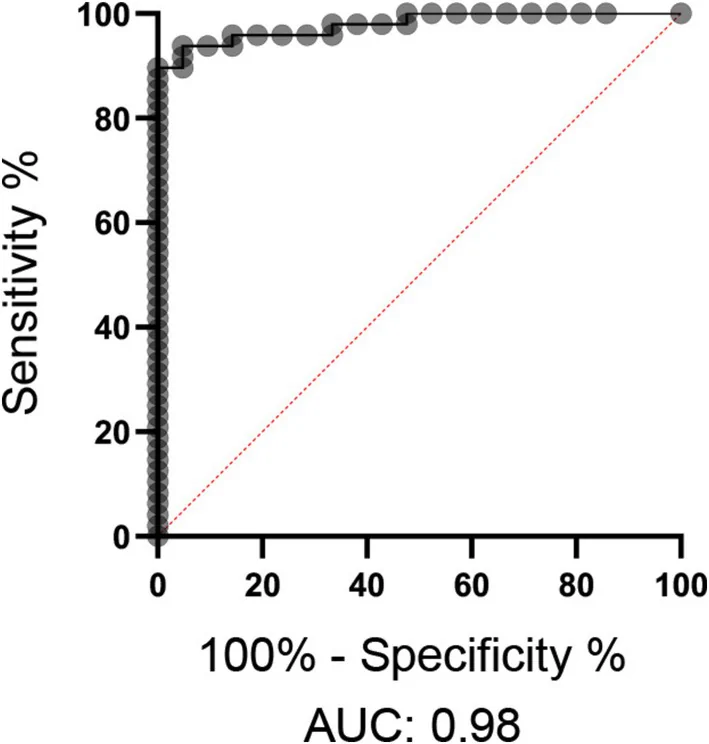
Figure 3 from the study: how well dcnc separated people with SPG4 (48) from healthy people (21). An AUC of 1 would mean perfect separation and 0.5 no better than chance; here the AUC is 0.98. Source: FIGURE 3 from Fattorini G et al. “Validation of a Cellular Imaging-Based Method as a Potential Biomarker for SPG4 Hereditary Spastic Paraplegia.” Ann Clin Transl Neurol 2026. doi:10.1002/acn3.70482. Licensed CC BY 4.0.
What it means for families
To test a future treatment, researchers need to see quickly whether it raises spastin levels. The authors consider dcnc a robust, non-invasive (from a blood sample) candidate that works for any variant type and deserves evaluation in future clinical trials.
What the study does not tell us yet
It is not a diagnostic test available from your doctor: SPG4 is still confirmed by genetic testing. The group was small, and the measure needs to be confirmed in other groups and, above all, in trials of real treatments.
References
- 1.
Fattorini G, Licursi V, Zanna GD, et al. (2026). Validation of a Cellular Imaging-Based Method as a Potential Biomarker for SPG4 Hereditary Spastic Paraplegia. Annals of Clinical and Translational Neurology (published online 2 September 2026).
PMID 42687129Last verified: 7 November 2026
A candidate SPG4 biomarker measured in blood cells (48 patients, 21 healthy people).
- 2.
Parodi L, Rydning SL, Tallaksen C, Durr A (2019). Spastic Paraplegia 4. GeneReviews®, University of Washington, Seattle (posted 2003; updated 13 June 2019).
PMID 20301339Last verified: 6 November 2026
The core clinical reference for SPG4: frequency, onset, symptoms, inheritance, diagnosis and symptomatic care.
Further sources
- DOI: 10.1002/acn3.70482 (opens in a new tab)doi.org
- PubMed Central: PMC13538279 (opens in a new tab)pmc.ncbi.nlm.nih.gov