A plain-language summary of a published scientific study. It is educational and does not replace medical advice.
The study: Jang MA et al., Scientific Reports, published online 30 May 2026. A cohort study. Free full text.
What the researchers studied
Little was known about hereditary spastic paraplegia (HSP) in Korea. The team genetically tested 657 patients with suspected HSP, using Sanger sequencing and a next-generation sequencing (NGS) panel of 54 genes. They also looked for deletions or duplications of pieces of genes (CNVs).
What they found
- A pathogenic or likely pathogenic variant was found in 121 patients (18%).
- Of those, 83% had variants in SPAST (the SPG4 gene) and 6% in ATL1.
- 5% of the SPAST variants were deletions or duplications.
- 23 new variants were discovered, 19 of them in SPAST.
- The NGS panel found the cause more often than Sanger sequencing: 25% versus 16%.
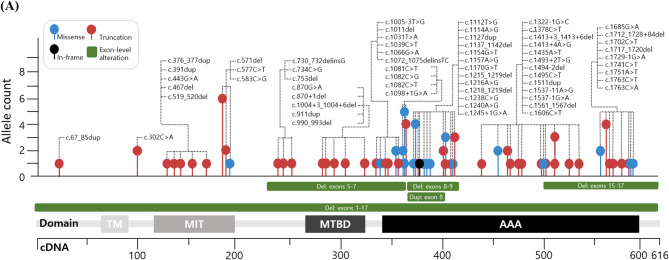
Figure 1 from the study: where on the SPAST gene the variants found in Korean patients lie. The green bars show deletions covering whole exons, one of them the entire gene (exons 1–17). Source: Fig. 1 from Jang MA et al. “Genetic landscape of hereditary spastic paraplegias in the Korean population.” Sci Rep 2026. doi:10.1038/s41598-026-53107-0. Licensed CC BY 4.0.
What it means for families
- A genetic test for SPG4 needs to look for deletions and duplications too, not only changes to single DNA letters. The authors stress how important detecting them is.
- A negative result does not rule out HSP: for most patients with suspected HSP in the study, no cause was found.
What the study does not tell us yet
The panel covered 54 genes, and the authors think broader methods (exome or genome) are needed for unsolved cases. The proportions are specific to the Korean population.
References
- 1.
Jang MA, Jang JH, Kim BJ, Sung DH (2026). Genetic landscape of hereditary spastic paraplegias in the Korean population. Scientific Reports 16(1).
PMID 42225730Last verified: 7 November 2026
657 patients in Korea: SPAST was the most frequent gene (83% of solved cases); 5% of SPAST variants were deletions or duplications.
Further sources
- DOI: 10.1038/s41598-026-53107-0 (opens in a new tab)doi.org
- PubMed Central: PMC13458517 (opens in a new tab)pmc.ncbi.nlm.nih.gov