A plain-language summary of a published scientific study. It is educational and does not replace medical advice.
The study: Lee Y et al., Signal Transduction and Targeted Therapy, published online 29 July 2026. A laboratory study. Free full text.
What the researchers studied
The team started from human stem cells and grew cortical organoids, small tissues resembling the brain's cortex. Some were then transplanted into mouse brains. In these models they recreated a deletion of exon 17 of SPAST caused by Alu sequences (repeated pieces of DNA found only in primates). The authors describe it as a frequent cause of SPG4 accompanied by dementia.
What they found
- The deletion "fuses" SPAST to its neighbour, SLC30A6. That gene makes ZnT6, a zinc transporter in the Golgi apparatus, the "post office" that sorts and packages the cell's proteins. The result: less ZnT6.
- In organoids with the deletion, zinc built up in the cell, the Golgi fragmented, fats were dysregulated, and more protein clumps (Aβ and ubiquitin) appeared. In the version transplanted into mice, the effects were stronger still.
- Reducing SLC30A6 in normal organoids produced the same problems, so ZnT6 appears essential.
- A zinc chelator (TPEN) or an antibody that prevents Golgi fragmentation significantly restored the Golgi's integrity and lowered Aβ levels.
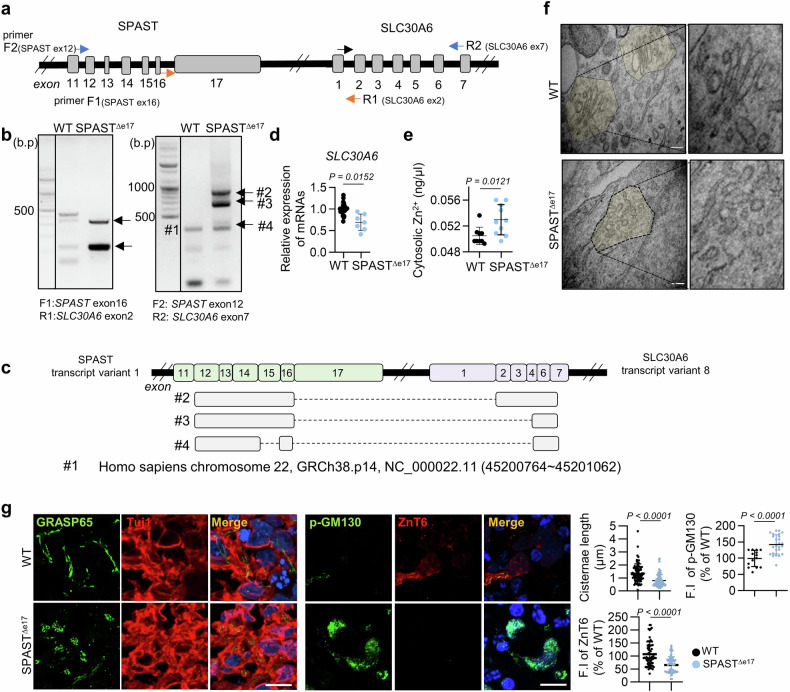
Figure 5 from the study: the exon 17 deletion joins SPAST to the neighbouring SLC30A6 gene (a–c). In organoids with the deletion, SLC30A6 is expressed less (d), zinc inside the cell rises (e), and the Golgi looks fragmented under the microscope (f, g). Source: Fig. 5 from Lee Y et al. “Alu-mediated SPAST deletion impairs golgi zinc transport and reveals a druggable vulnerability.” Signal Transduct Target Ther 2026. doi:10.1038/s41392-026-02785-3. Licensed CC BY-NC-ND 4.0.
What it means for families
The study explains why one particular kind of deletion can have effects beyond the loss of spastin: a neighbouring gene is affected too. The findings concern this specific deletion, not all SPAST variants, so it is worth asking the clinical geneticist what type of variant your family member has.
What the study does not tell us yet
Everything happened in laboratory models. TPEN and the antibody used are not treatments available to patients. The authors see the ZnT6–Golgi axis as a possible future treatment target, including for some cases of Alzheimer's disease, but this still has to be shown.
References
- 1.
Lee Y, Ham O, Lee H, et al. (2026). Alu-mediated SPAST deletion impairs golgi zinc transport and reveals a druggable vulnerability. Signal Transduction and Targeted Therapy 11(1).
PMID 42521669Last verified: 7 November 2026
Brain organoids: a SPAST deletion (exon 17) disrupts zinc transport and the Golgi apparatus.
Further sources
- DOI: 10.1038/s41392-026-02785-3 (opens in a new tab)doi.org
- PubMed Central: PMC13416153 (opens in a new tab)pmc.ncbi.nlm.nih.gov