
A plain-language summary of a published scientific study. It is educational and does not replace medical advice.
The study: Gude S et al., JACC: Case Reports, published online 3 June 2026. A case report. Free full text.
What happened
A 54-year-old woman with genetically confirmed SPG4 saw her doctor because of worsening breathlessness and a new left bundle branch block, a delay in the heart's electrical signal. Ultrasound and cardiac MRI showed non-ischaemic dilated cardiomyopathy: the heart was enlarged and pumping weakly, and the cause was not narrowed arteries. The heart's contraction was also out of sync.
What the doctors found
- Other causes were ruled out, and an extended genetic test for cardiomyopathies was negative.
- With standard heart-failure treatment her symptoms improved. Because her heart function stayed low, she received a device that resynchronises the heartbeat and can stop a dangerous arrhythmia.
- Her mother also had HSP and heart failure (see the figure).
- To the authors' knowledge, this is the first reported case of SPG4 together with this heart condition.
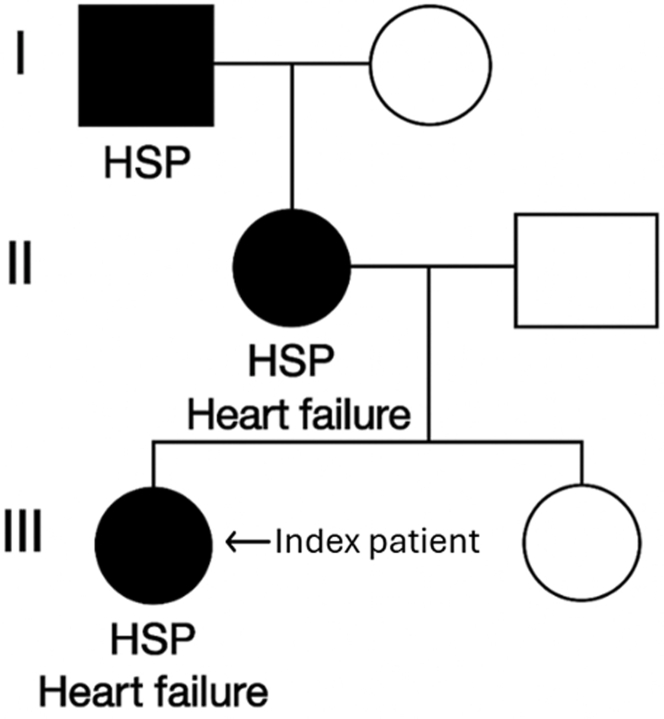
Figure 1 from the study: the family tree. The patient (arrow) carries the SPG4 variant and developed heart failure, as did her mother. Source: Figure 1 from Gude S et al. “Dilated Cardiomyopathy in a Woman With SPG4-Associated Hereditary Spastic Paraplegia.” JACC Case Rep 2026. doi:10.1016/j.jaccas.2026.108746. Licensed CC BY-NC-ND 4.0.
What it means for families
The authors recommend a structured heart assessment for people with SPG4 who have heart symptoms, such as breathlessness on exertion. Standard heart treatments still apply. A commentary by two cardiologists in the same journal also suggests an electrocardiogram as a simple test.
What the study does not tell us yet
This is a single case. The authors state clearly that it cannot be said whether SPG4 caused the heart condition. There is no evidence that SPG4 commonly affects the heart.
References
- 1.
Gude S, Kleiven Ø, Edvardsen T (2026). Dilated Cardiomyopathy in a Woman With SPG4-Associated Hereditary Spastic Paraplegia. JACC: Case Reports 31(32):108746.
PMID 42233908Last verified: 7 November 2026
First reported case of SPG4 together with dilated cardiomyopathy; a causal link is not proven.
- 2.
Panjrath G, Dakhakhni M (2026). SPG4-Associated Hereditary Spastic Paraplegia and Dilated Cardiomyopathy: Coincidence or Clue?. JACC: Case Reports 31(32):109565 (editorial comment).
PMID 42593014Last verified: 7 November 2026
Commentary: there are no cardiac screening recommendations for SPG4 yet.
Further sources
- DOI: 10.1016/j.jaccas.2026.108746 (opens in a new tab)doi.org
- PubMed Central: PMC13480284 (opens in a new tab)pmc.ncbi.nlm.nih.gov