
A plain-language summary of a published scientific study. It is educational and does not replace medical advice.
The study: Davarzani A et al., Orphanet Journal of Rare Diseases, published online 12 May 2026. A cohort study. Free full text.
What the researchers studied
Hereditary spastic paraplegia (HSP) can be caused by more than 90 genes and comes in pure forms (mainly leg stiffness and weakness) and complicated forms with additional symptoms. The team performed exome sequencing on 103 unrelated patients in Iran with suspected HSP.
What they found
- 71 variants were found in 81 patients. The authors count 78.6% of patients as genetically solved, although some of the variants are of uncertain significance.
- 64 patients had variants in known HSP genes, 14 in genes for other neuromuscular or neurodegenerative conditions, and 3 in four new candidate genes (NMNAT1, SEMA3A, KCNJ14, EMP3).
- 37 genes were involved in total. The subtypes SPG11, SPG4, SPG7 and SPG15 together made up about 40% of the group.
- No genetic cause was found for 22 patients.
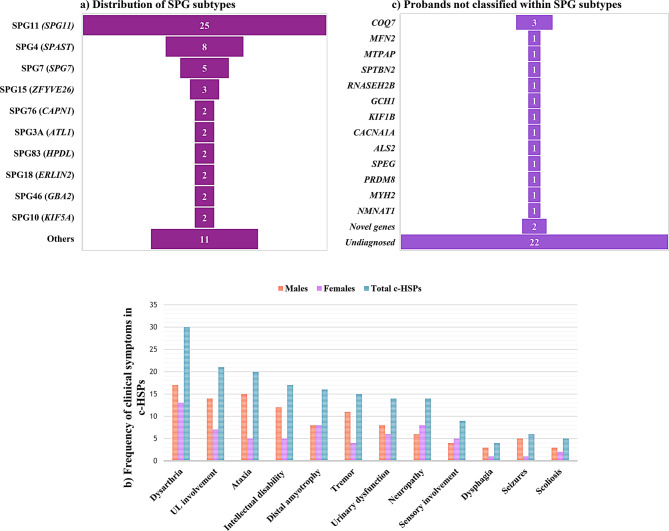
Figure 2 from the study: (a) the distribution of HSP subtypes in the group; (b) the most common symptoms in complicated forms; (c) patients with variants in other genes and those left without a diagnosis. Source: Fig. 2 from Davarzani A et al. “Expanding the genetic and clinical landscapes of hereditary spastic paraplegia (HSP): a cohort study of 103 families.” Orphanet J Rare Dis 2026. doi:10.1186/s13023-026-04373-8. Licensed CC BY 4.0.
What it means for families
HSP is very varied, and some cases overlap with other neurological conditions with which they share biological mechanisms. A broad genetic test such as an exome can find causes that a test limited to a few genes would miss.
What the study does not tell us yet
The share of "solved" cases includes variants that are still uncertain and need confirming. The 22 undiagnosed patients suggest there are HSP genes still to be discovered. The proportions are specific to this population.
References
- 1.
Davarzani A, Ravanbod M, Ghasemi A, et al. (2026). Expanding the genetic and clinical landscapes of hereditary spastic paraplegia (HSP): a cohort study of 103 families. Orphanet Journal of Rare Diseases 21(1).
PMID 42120987Last verified: 7 November 2026
103 families in Iran, exome sequencing: a variant found in 78.6% (including uncertain variants).
Further sources
- DOI: 10.1186/s13023-026-04373-8 (opens in a new tab)doi.org
- PubMed Central: PMC13353007 (opens in a new tab)pmc.ncbi.nlm.nih.gov