
A plain-language summary of a published scientific study. It is educational and does not replace medical advice.
The study: Piermarini E, Baas PW, Movement Disorders, published online 31 July 2026. A literature review. Free full text.
What the review explains
- In hereditary spastic paraplegias (HSP), the long nerve fibres running from the brain to the lower spinal cord gradually degenerate. This causes leg weakness and stiffness and walking difficulties.
- Other nerve pathways can be affected too, so some forms of HSP include bladder or bowel problems, speech problems or intellectual disability.
- SPG4 is the most common form and is caused by variants in the SPAST gene, which makes spastin. Spastin "cuts" microtubules, the tracks along which materials travel inside nerve cells, and also has roles linked to cell membranes.
Where research stands
The authors write that significant progress has been made in laboratory models of SPG4 and in understanding how the disease works. On that basis, work is under way on a flexible treatment plan meant for patients at any stage of the disease.
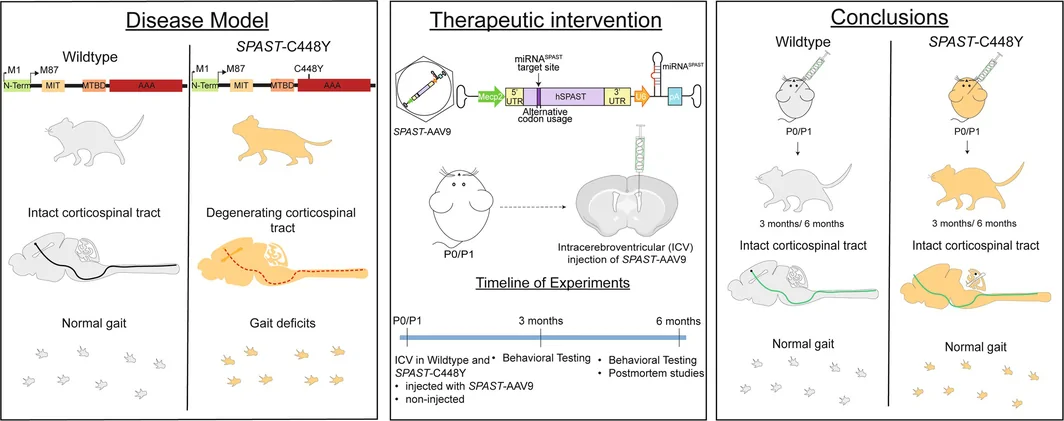
Figure 4 from the review: summary of a gene therapy study in mice with the SPAST-C448Y variant. Left: without treatment, the motor nerve fibres (the corticospinal tract) degenerate and walking problems appear. Middle: the treatment was injected into the brain's ventricles in the first days after birth. Right: at 3 and 6 months, treated mice had an intact tract and walked normally. Source: FIG. 4 from Piermarini E et al. “SPG4 Hereditary Spastic Paraplegia: From Etiology to Therapy.” Mov Disord 2026. doi:10.1002/mds.70453. Licensed CC BY-NC-ND 4.0.
What it means for families
The review gives an overview of research directions. The gene therapy in the figure prevented symptoms in newborn mice, but it has not been tested in people. On 6 November 2026 there was no registered clinical trial on ClinicalTrials.gov of a treatment that changes the course of SPG4.
What the study does not tell us yet
Results in mice do not automatically hold in people. It is not yet known whether the timing of treatment would matter in people, or how safe it would be.
References
- 1.
Piermarini E, Baas PW (2026). SPG4 hereditary spastic paraplegia: from etiology to therapy. Movement Disorders 41(10):2592–2605.
PMID 42538614Last verified: 6 November 2026
The most recent review of SPG4 causes and therapeutic directions.
- 2.
Piermarini E, Guha S, Qiang L, et al. (2026). Intracerebroventricular SPAST-AAV9 gene therapy prevents manifestation of symptoms in a mouse model of SPG4 hereditary spastic paraplegia. Molecular Therapy 34(3):1729–1742.
PMID 41311060Last verified: 6 November 2026
‘Silence-and-replace’ gene therapy in newborn mice: prevented symptoms. Not tested in humans.
- 3.
U.S. National Library of Medicine (2026). ClinicalTrials.gov — studies listing SPG4 / SPAST (search of 6 November 2026). ClinicalTrials.gov.
clinicaltrials.govLast verified: 6 November 2026
At the time of the search there was no interventional study of a disease-modifying treatment specific to SPG4.
Further sources
- DOI: 10.1002/mds.70453 (opens in a new tab)doi.org
- PubMed Central: PMC13686115 (opens in a new tab)pmc.ncbi.nlm.nih.gov